The Crucifixion by Jacopo Tintoretto

The Crucifixion by Jacopo Tintoretto

Thursday, September 4, 2014

On the Religion of the Day


 John Henry Newman often employed the phrase “the religion of the day”, referring to the sentiments of modern religion, its emphases, priorities and its decidedness in certain areas of the religious life, and its lethargy, quietness and its inactivity in others. In one of this sermons he relates to his flock-
“When its (religion’s) terrors disappear, then disappear also, in the creed of the day, those fearful images of Divine wrath with which the Scriptures abound. They are explained away. Every thing is bright and cheerful. Religion is pleasant and easy; benevolence is the chief virtue; intolerance, bigotry, excess of zeal, are the first of sins. Austerity is an absurdity; even firmness is looked on with an unfriendly, suspicious eye.” 
Newman seems to have caught this grave evil much before our time and warned his flock of it. But today the modern catholic is imbued and overrun with notions nearly identical to what Newman condemned one hundred and fifty years ago. Today there is an endless gush of friendliness and community from pulpits, cascades of kindness and pleasantness, even ejections on climate change, gun control, animal treatment. All these are normal Sunday fare for the modern catholic. But to him, hell, satan, eternal damnation, fasting, heresy, mortal sin, confession and all of this genus are foreign and taboo It is medieval nonsense that is no longer relevant but   “judgmental”, and to most speaking of these things is “unchristian”.


Presently there is an obsession with avoiding such topics; no one can talk about them, not the priest at the pulpit, nor any faithful Catholics. “Pope Francis would never say such things.” is the common jingle. But Newman testifies it is the Devil who has worked this modern religious idea that is contrary to the true faith.
“What is the world's religion now? It has taken the brighter side of the Gospel,—its tidings of comfort, its precepts of love; all darker, deeper views of man's condition and prospects being comparatively forgotten. This is the religion natural to a civilized age, and well has Satan dressed and completed it into an idol of the Truth.”

And here we are today one hundred and fifty years later, and still this false conception of Christianity not only looms, but has become so influential and so preeminent that it now flexes it power to excuse modern social evils that are clearly condemned by Scriptures and Church Tradition. And those who dare to stand up against these are rejected as bigots, extremists, and zealots unless they will so candy-coat the plain truth as to make it nearly unrecognizable from the crystal-clear teachings of our fathers in faith.
"Still, after all, here is an existing teaching, only partially evangelical, built upon worldly principle, yet pretending to be the Gospel, dropping one whole side of the Gospel, it's austere character, and considering it enough to be benevolent, courteous, candid, correct in conduct, delicate,-though it includes no true fear of God, no fervent zeal for His honor, no deep hatred of sin, no horror at the sight of sinners, no indignation and compassion at the blasphemies of heretics, no jealous adherence to doctrinal truth... no loyalty to the Holy Apostolic Church, of which the Creed speaks, no sense of the authority of religion as external to the mind: in a word, no seriousness."

The Catholics who have the faith to stand in the tradition of the Fathers and preach the entire faith, even its less appealing truths, are seen as unkind because they will not disguise the teaching of the church so exhaustively in pleasant phrases as to render them meaningless.  Others, who cannot swallow the admonitions and plainness of the fathers, look on and will rebuke, saying that modern religion has no place for “intolerance.” Unfortunately often it is firstly the clergy who level this claim against those who believe in all the truths of the faith.

They will even go so far as to twist saintly personages into fluffy characters. St. Anthony of Padua, once revered for his defense of the true faith was known as the Hammer of Heretics, now all he is known for is playing with Baby Jesus and finding keys. St. Francis of Assisi, known for his love of birds and hatred of fossil fuels once said “We should realize that no matter where or how a man dies, if he is in the state of mortal sin and does not repent, when he could have done so and did not, the devil tears his soul from his body with such anguish and distress that only a person who has experienced it can appreciate it.”

The Angelic Doctor St. Thomas Aquinas, who is held by Catholics as the foremost philosopher and theologian once exclaimed, "The worst wolves in sheep's clothing are the heretics and then bad prelates." But today his words are too strong, his hatred of heresy so antiquated that only his more neutral and mild writings, or at least those free from any of the divisive topics opposed to the religion of today are ever sited. All of these personages and many more have been twisted, their offensive writings and sermons ignored to fit the religion of this age.
"The worst kind of heretic is the one who, while teaching mostly true Catholic doctrine, adds a word of heresy, like a drop of poison in a cup of water."- Pope Leo XIII
There is a war between the truth and the “drop of poison” which has fallen into the Cup of the Holy Church, making the new drink so much smoother and more pleasant but at the same time stripping it of its purity, integrity, and holiness. So may this modern religion be despised as the work of the devil as Newman said, and may the zeal that Newman desires ever increase in the Church and Her members that the truth may be proclaimed ever more. Even in the face of every modern resistance, clerical, political, and all others, the truth must be proclaimed and the world must be converted. So may the religion of our day die a horrible death and may the Catholicism of our Fathers once again shine forth for the conversion of the world!


Tuesday, September 2, 2014

Lugano & Bellinzona, weekend #2

A note before this past weekend

I have realized that while I take plenty of pictures of churches I don't take enough pictures of anything else, so that is my resolution for the week, I will try to diversify my blog photos.

This past weekend I spent the week locally, staying at the villa. Just fifteen minutes north by train is the small city of Lugano. It is a very wealthy city with more designer stores than I have seen in my visits to New York City. We took the local train early afternoon friday to spend some time seeing the city. It was a wonderful weekend to be there because there was a jazz festival throughout the city. There are many small plazas in the city and each of them had a stage with a band performing. So as we walked we passed through crowds listening to whatever band was performing and enjoyed some free entertainment. Lugano is on a lake and enjoys miles of lakefront views. After a few hours touring the city we settled down at a little open air water front bar named the Mojito Bar. We enjoyed a drink and the view as the sun began to sink behind the mountains.  After the night had ended we headed back to Riva.


The next day we took our time getting up and late in the morning took the train north about forty five minutes to the town of Bellinzona. Bellinzona is a beautiful little town that boasts an amazing statistic. Bellinzona is the home of three UNESCO World Heritage Sites. Three castles, 
Castelgrande, Montebello, and Sasso Corbaro sit on the hills overlooking the town. But before making our way to these remarkable remains we spent some time in the weekly market.


The market ran through the old part of the town, many blocks of local vendors sold their wares, goods and produce. There were lots of local cheeses meats and scarfs as well as clothing jewelry and other nick-nacks for the buying . The market was cool, but I had to write a paper on it and it wasn't nearly as awesome as the castles and churches, so lets keep moving.


What really caught my attention wandering about the market was an old church that sat overlooking one of the main plazas. Of course I found my way inside to what was incidentally the Bellinzona Cathedral, dedicated to St. Peter. It was a gorgeous church, built in the baroque style and in amazingly pristine condition, the side altars were particularly notable in their ornateness. It was a beautiful sanctuary away from the clamor of the noisy street.


The first time in I was with the group so I only stopped in for a few minutes and then kept on moving. After we had seen our fill of the market we sat down in one of the plazas to eat our bagged lunches. Afterwards we headed up the hill to the first castle, Castelgrande.


The castle is jaw dropping, as you can see it is surrounded by vineyards and in the distance on top of the nearest hill is another of the castles, and the third sits out of sight just below it. Bellinzona sits in a valley critical for north-south trade, and the rampart from which the above picture was taken stretches almost all the way across the width of the valley, ensuring that no travelers or merchants could pass without paying a tax.


After Castlegrande we came back down into the valley and up another hill to castle number two. You can see Castlegrande as well as downtown  from the picture above. Below is a picture of the Castle Montebello. We spent some time in Castle Montebello recovering from a rigorous hike up and enjoying the view of the city, the other castles, and mountains. After a while we hiked down the mountain and back into the city. From there our group decided to take a break from a long day in motion to sit down and enjoy a beer at a local cafe. We had received a map of the city earlier that day, and there were a couple of churches found on the map that we had not seen and I decided I wanted to see those. So I broke off from the group to find my way to some of the local churches.


I walked about a mile south out of town. Being a church hunter is an adventurous experience. Especially when searching to find a church off the beaten pass, you are always making a bet, especially in the modern day. Churches are often closed. In the modern day when the best you can hope for is a couple of old ladies in quiet prayer and when vandalism is prevalent, churches are often closed when Mass is not being offered, especially churches that are not accustomed to many visitors. So you may walk two miles in the blistering heat to find a closed Church. This is the most common disappointment.  I'm sure I will introduce other aspects of my church hunting experiences as the semester goes on but Bellinzona was good to me. 


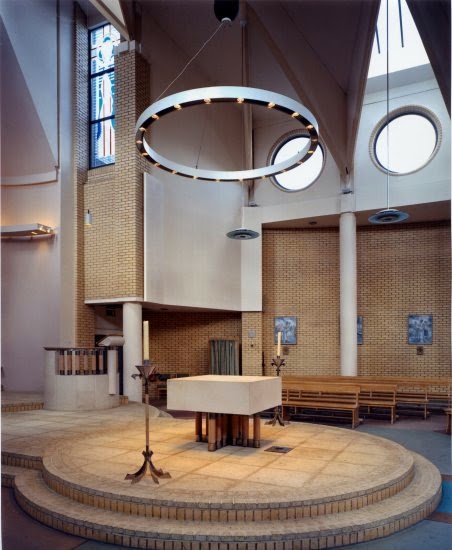
My walk was well worth it. I came upon Santa Maria delle Grazie, a little parish church with a beautiful mural of the life of Christ centered around the Passion. I spent some time in wonder and prayer. The church seemed in good condition, and for the liturgically savvy interestingly enough, this parish church did not have a table altar. Anyway I enjoyed the church but having to make a train, and a few churches left to see so I headed out. There was another Church just half a mile away, I tried to get there, but the local train tracks would have sent me a mile farther down the road to back track three quarters of the way. After surveying the train tracks and the wall on the opposite side and discerning I could not cross the tracks and hop the fence. I decided I didn't have time for this one and hustled my way back into the city.


I spent about twenty minutes in the Cathedral once again for some personal prayer time. Then I found my last church for the day, St. Giovanni. Again, a beautiful baroque church, and a little out from the main street in town, so it had a few locals at prayer. My train schedule kept me on my toes and as I realized they were preparing for Mass to begin I found my way out and back to the train station, on a train and back to Riva.


Friday, August 29, 2014

On Lost Reverence

Once upon a long lost time ago, the altar server, knowing that the priest he served was about to consecrate the host into the Body of God, would kiss the hands of the priest as he received his Berreta(hats priests once wore during parts of the liturgy), and knowing that the water and wine that poured forth from the cruets were to become the blood that streamed from Christ's side to revive the bones of Adam, the server kissed the cruets when he handed them to the priest and when he received them back. The sacristan if not given explicit permission to touch the sacred vessels, wore white gloves, because the Church rightly knew, as well as he, that he was unworthy to touch the vessels which would contain God Himself.

And the faithful, full of reverence, approached fearfully to kneel before the Lord, to receive Him into themselves in the Eucharist. For as the Angelic Doctor, St. Thomas Aquinas states "...because out of reverence towards this sacrament, nothing touches it but what is consecrated, and likewise the priest's hands, for touching this sacrament. Hence it is not lawful for anyone to touch it, except for necessity, for instance if it were to fall upon the ground, or else in some other case of urgency."-ST III Q 82 Art 3


Man used to kneel before his Creator, he spent the majority of the Holy Mass on his knees, and rightly so. For the Church directed, so that man, by his outward posture was informed internally to the magnificent reality that was unfolding before his eyes, of which he was unworthy to partake in.

Have not these noble and sacred traditions served the faithful dutifully, preserving and passing on the faith for ages?

But today, we declare it is no longer necessary for man to kneel! His kneeling is of no importance, it hurts too much and is far to inconvenient. It is not important, to prostrate yourself before He that created you, redeemed you, and sustains you in existence? We endeavor to over-spiritualize worship, neglecting the reality that man is body and soul. Man worships with both his body and his soul, each informing the other.

We would do well to note that the first time that kneeling was purged from christian worship was in protestant churches, who did not want their congregations to worship the host. They understood better than we do now that "External actions are signs of internal reverence."-ST II-II Q 84, Art 1.

Cardinal Schneider tells us in his book Dominus Est-It is the Lord! "On the other hand, Zwingli, Calvin, and their successors, who denied the Real Presence introduced...Communion given on the hand and standing" and a paragraph later "Very early the people(protestants) might have knelt during during the prayer(Lord's Supper) and also received Communion kneeling but... several synods forbade this in order to avoid any suggestion that the bread was to be venerated."


We follow liturgical postures in the footsteps of those who do not believe in the Real Presence, and who actually abolished kneeling to rid their congregations of this belief, and then wonder why one third of Catholics do not believe in the doctrine of the Real Presence. Have we still not accepted the overwhelmingly likely chance, that Catholics don't believe in the Real Presence because we no longer treat Christ like He is actually there...

What does it say when a catholic receives the Eucharist as casually as a protestant receives his wafer at his own service?

It only takes a short look to see that reverence has been removed from our churches, by direct order and by omission, for far too long, and undeniably to the detriment of the Catholic Faith. The Church must now work harder than ever to once again show terribly uncatechized Catholics that their faith has depth, meaning, and is in fact the true faith; that it is not simply a wish-washy feely-goody banners and balloons church, but that it can withstand the meticulous scrutiny of doubters and possesses truths worth dying for.

Certainly Catholics of today have been taught that obvious forms of lack of respect are acceptable, as I have been taught, and certainly they are not bad people for this. On the contrary they are the faithful who have looked to their shepherds, and have been told that reverence is no longer a mainstay of catholic life and devotion. And so I do not criticize the Catholics who receive in any manner, but instead I make a call for a reevaluation of the diminution of traditional reverence.

 For half a century Holy Mother Church has tried an approach of relative laxity in enforcement and catechesis as to reverence. Can we say that anything positive has come from it? What has been the gain? What good fruits have come from the abolition of conscientious reverence and where are these fruits? Maybe it is time to once again change course, and return to more formal emphasis and instruction on due reverence in the House of God.

Certainly the future will contain more of my thoughts on this subject, and in further detail, but suffice it to say this much for now.


Tuesday, August 26, 2014


This is a public service announcement: for the next semester as I study abroad I will be posting and documenting my travels. I have to do this for class but it is pleasurable as well. The travel posts will be mixed in with the other posts, which I hope to start again after a literarily bleak but very busy summer.

Now to Europe!

This past Friday after a few days in Barcelona I made it to Riva San Vitale, Switzerland.  Chris, An and I were in of the middle pack of arrivals and we spent most of the day walking about the town, meeting new people and helping them haul their luggage up the stairs. I took an evening rosary walk around the town, mainly to check out the churches. There are quite a few in town, but I haven’t done a good job photographing them so far but I enjoy visiting them often. Below is a view of the main church, from the balcony of the Villa we are living in.  Behind it is a very small church, called a baptistery, which is the oldest standing Christian structure in Switzerland, from the 6th century.


There is a beautiful lake that Riva sits on. If you walk a few minutes north from the villa you walk through “down town” Riva and then run into it. Riva is flanked on either side by mountains, some of which you can see in the picture. It is a quiet town with not much more activity most of the time other than a few cars speeding down the street. There is an elementary school across the street and it will be interesting to see the activity incited with the beginning of school.

We spent the Saturday with a lot of free time mixed in with orientation. We went on a tour of the town given by a lady who works as the building manager of the villa and who is also a local. I went to a Vigil Mass with the locals at the Church of the Holy Cross, just a five-minute walk past the one pictured. 

On Saturday some of the group went on a hike up the mountain behind the villa and another group went to Milan, which is about a one-hour train ride. I chose Milan.


Arriving at the central train station we purchased metro passes and headed further into the city. Milan is the “fashion capital of the world”, this we quickly learned passing by every designer brand name store I could name, though that is not many. We were turned loose in the city center after a quick tour of the city. First thing I did was eat lunch in front of the Milan Cathedral.

This church is nuts. It is incredible and the intricate craftsmanship is almost beyond belief. You are allowed to ascend a spiral staircase on the side of the Cathedral to climb to its roof. We took the opportunity. You are able to walk all over the roof of the Cathedral and almost touch the numberless spires ascending from the church. Even in the most obscure places on the roof of the church we found ornate sculptures of saints, angels and gargoyles. I must officially proclaim the Milan Cathedral as my new favorite church. Inside, in the crypt the great Milanese bishop, St. Charles Borromeo is buried.


After seeing the church, which took up most of my free time, Chris and I went to another two churches we had seen coming in. We were going to grab a beer at a local eatery but with time running out we just met the group at the rendezvous point and headed back to Riva.  I hope to return to Milan to see some of the rest of the City, and spend some more time in this magnificent wonder!


Saturday, May 17, 2014

Pride, the Root of Man's Destruction

Classical Christian morality has always said that pride is the root of all evil. As Ecclesiasticus(also known as Sirach) 10:14-15 tells us "The beginning of the pride of man, is to fall off from God. Because his heart is departed from Him that made him: for pride is the beginning of all sin: he that holdeth it, shall be filled with maledictions, and it shall ruin him in the end. "

St. Thomas Aquinas tells us "hence it is that pride fulfills the conditions of a first thing, and is the beginning of all sins"-Summa Theologica II-II Q 162. Art 7

Before us then is the witness of not only scripture, but also the witness of the saints. But what makes pride, the bottom-of-the-barrel evil, very fountainhead from which evil flows? Why can't programming computer viruses, or killing bunnies be the root of all evil?

The answer is really quite simple. The man who sins places his own Will above the Will of God. That is, sin is moral evil. God is goodness. He is, as scripture tells us, Truth. And thus we all know that obviously sin is incompatible with the will of God.


Next we all know from kindergarten CCD that God rules. He is sovereign Lord and all things are to be conformed to His Will. This is our purpose and our end, to conform without deviation, our will with God's. As Lesson 1 from the Baltimore Catechism answers the question: "Why did God make us? God made us to show forth His goodness and to share with us His everlasting happiness in Heaven"-BC L. 1, Q 3.

So to sin is to reject the Will of the God, and we are made to conform to the Will of God. And not only this, but to sin is to give primacy to our will instead of God's. And what does a man think who does this? He believes that he knows better than God. He believes that his own judgement is superior to the One who made him. And here in lies pride.

In each sin we commit, we falsely believe that our own decision, which does not bend its knee to the Will of the Infinite Creator, is superior to His. Thus, with every sin we choose to commit, we reject the authority of God and set ourselves up, even if only momentarily, as our own god.


Saturday, May 3, 2014

On a Broken Heart and an Abandoned Church


I am a church hunter. Wherever I go I am always on the lookout for beautiful churches to stop into. In fact before I enter into any city or town, even if I am just passing through, I often do a brief skim of the web to see if there are any notably beautiful churches that I can stop into. And it is like Easter morning when I find a beautiful church that I can stop by, even if just for a few minutes, to admire and to pray in.

So why do I love beautiful churches? Firstly I love beauty. There is a notable and distressing lack of true beauty being produced in out modern age, from music to paintings to architecture, our age is no competition when paired against our forefathers. The regrettable scarcity of transcendent beauty in our day and age makes that which has survived our iconoclastic era all the more radiant.

But more than just the natural beauty, beautiful churches radiate faith. Last summer I spent a few days in Cincinnati working on pro-life outreach. We spent our nights at the Knights of Columbus Council hall attached to St. William Parish on the West Side of the city. We were blessed one evening when the pastor gave us a tour of the church.


The church had been built after World War I. When all of the soldiers of the families belonging to the parish came back from the war alive, the people celebrated by building a new church. The church, by todays standards, looks like a cathedral. Resplendent with beauty, truly these people in their faith left no detail unaccounted for.  And to this day the diamond in the rough that is St. Williams is cared for by a community who is still thankful.

More than the fine artistry, it is the incredible faith that is built into churches like this one, that make it come alive. Infinitely more than just marble, glass and stone, these buildings were a labour of love, and are a testimony to the faith of generations past. Generations who would sacrifice, who gave of themselves that magnificent buildings could be realized and brought to fruition, all for the glorification of the generous All Mighty. From these places, built by faith, proliferates not only faith, but an intangible primordial beauty, that is more than brick and mortar. It is truly the beauty of that faith, that is built into the meticulously carved marble, into the carefully, delicately crafted stain glass, into the stone, cut with devotion. This is what brings me to these Churches, and what makes, even their corporeal appearance superior to the greatest monuments and museums, the faith that was put into them now exudes out of them.

A few winters ago I traveled to Germany, and while there I was blessed to be able to stop in a small city by the name of Ulm. It is located in southern Germany along the Danube River. In the city there is a "cathedral" called the "Ulm Minster", which holds the record for the tallest church steeple in the world. The church has unique beginnings, instead of the Catholic Church funding the construction, the faithful of Ulm chose to fund the church themselves, and thus they created one of the most beautiful, and certainly the tallest, church in the world.


Built in(my personal favorite) the High-Gothic architecture, with the distinct flying buttresses, the church is a sight to be had. It was certainly built with the same love, attention, fealty and reverence as St. William. But as I walked through the church I felt a sadness, the Church has been stripped down. On the interior, on either side of the apse, there are store piles of pews and other materials; just from looking one can tell that the apse, once held a grand high altar, but has now been deprived of its former beauty with choir stalls in disrepair on either side. 

But what of it? Some may say, there are far greater injustices in the world than the non-pristine upkeep of an ancient church, and I would agree. But my heart laid heavy when I walked through Ulm Minster. You could feel the devotion under dirt on the walls, crying to break through. I could sense the devotion of the faithful who built it, but it was muted, restrained, and stifled by the absence of faith, that now filled the cold cathedral. It had been turned into a tourist destination. No longer did it serve its purpose, that for which it was built with all faith. It was not created for tourists to buzz through on their way to Munich. It was made to edify the people of Ulm, to give glory to Christ, and to enliven the faithful to the mysteries that the Church there in celebrated, especially the august sacrifice of the Mass.


The church that is no longer treated, firstly and chiefly as a house of prayer, especially for the Mass and other sacraments, has lost its meaning and its purpose has been muddied. What I see, is the faith of the ones who built it, that is now insulted by the lack of faith in present times. All over Europe and the whole world, there are beautiful churches, built with the faith that I have talked about, that are falling apart, because that faith no longer lives there in. What a contradiction, a palace built for the glory of God, now treated as a museum for us "enlightened" folk. The physical mark of faith remains, but the faith is gone.

I hope that one day the world will once again be full of the faith that once built these magnificent edifices. Then when people like myself in times to come, will enter these exquisite buildings, they will no longer be saddened by the beauty of a faith that has passed, but be filled with the joy of a church full of faithful, once again serving the purpose for which it was built.